

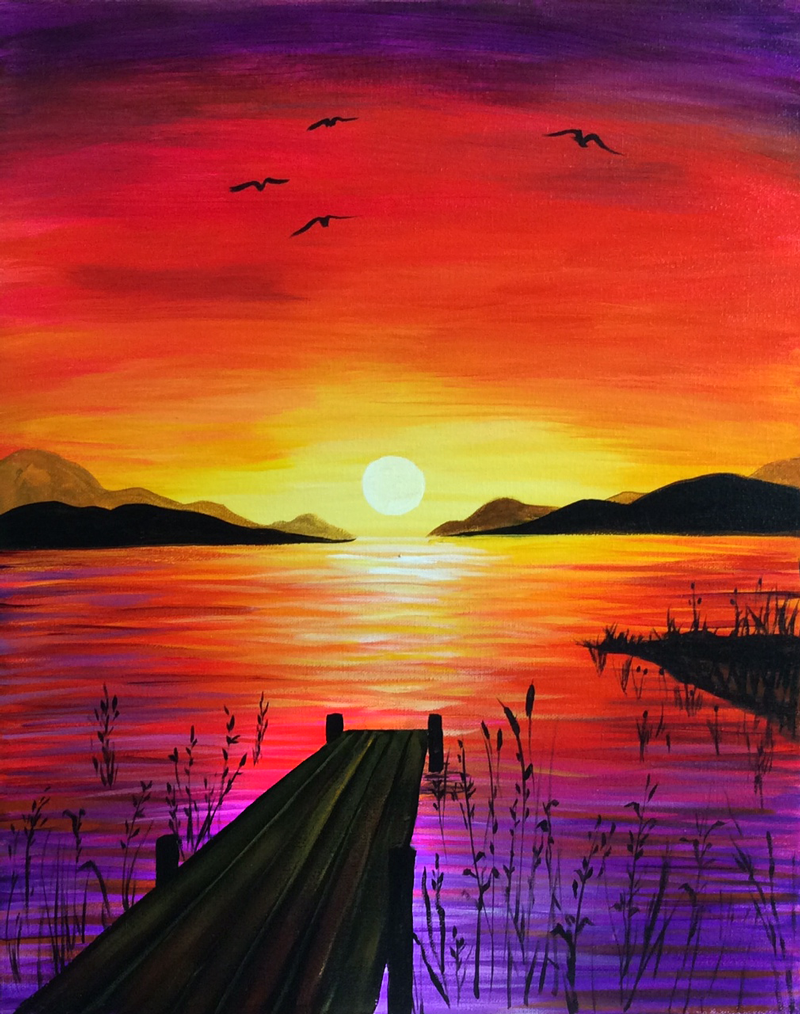
Just as the painter combines a wide repertoire of brush stroke techniques to create an image, the writer chooses from a repertoire of sentence structures.
When painting a beautiful sunset, there are certain brush strokes being made to make it look the way you want it to. Just like in writing, we use certain brush strokes (participles, absolutes, appositives, action verbs, and adjectives shifted out of order) to make our writing our own. Using brush strokes in painting and in writing is a way of making it our own and add more beauty to it. As with any decision we make in our life, we are using a certain brush stroke so that we can make the story of our lives our own. In “Painting with Five Brushstrokes” an author explains the basic techniques to best create an image for readers.
PARTICIPLES
In my opinion, participles help you see the action. We can more easily see the action happening. A participle is an “ing” verb that is attached to the beginning or end of a sentence. As I said at the beginning, a participle helps describe what an author wants the audience to picture.
Example ~ Running and screaming, the child was scared for their life.
In this example, “running and screaming” helps describe what the child is doing so that it evokes the reader to picture the scene.
APPOSITIVES
An appositive is something that contains essential information to the meaning of a sentence. It contributes necessary information to understand what is being said, in my opinion. An appositive is a noun or pronoun that explains another noun or pronoun in that sentence. Most of the time, appositives are used with modifiers to form an appositive phrase.
Example ~ The manuals, keyboards, are played with their hands.
In this example, keyboards modifies the noun manuals to explain it more and add more essential information.
ACTION VERBS
Action verb energizes the story and eliminates passive voices. They describe the action and explain what the subject of the sentence is doing. They do that to describe both physical and mental actions.
Example ~ Abby trotted to the ball and wound up her leg to kick the ball to a teammate.
In the example, using “trotted” and “wound up” are action verbs describing what is going on rather than using a passive tone such as “Abby kicked the ball.” This example makes the sentence more exciting.
ABSOLUTES
My way of deciphering absolutes from any other brushstroke is that is an incomplete sentence but if you add was or were it becomes a complete sentence. Like most of the brushstrokes, an absolute is a noun combined with an “ing” participle.
Example ~ Her eyes sparkling, she starred up to the stars.
In this sentence “her eyes sparkling” it is an “ing” at the beginning of a sentence and it as an incomplete sentence that becomes a sentence when adding was or were.
ADJECTIVES SHIFTED OUT OF ORDER
Adjectives out of order are used more for those authors that create fiction because they can amplify the details of an image. When using this one leaves one adjective where it was and shifts and the other two adjectives out of order.
Example ~ The child, youthful and full of smiles, played with her puppy the entire afternoon.

 Marissa's Truth